Uncategorized
Russell Westbrook Retirement: Inside a Legendary 18-Year NBA Career That Redefined the Triple-Double
Aug
Russell Westbrook did not announce the end of his NBA career from a podium surrounded by microphones.
Instead, one of the league’s most expressive competitors let a carefully produced video tell the story.
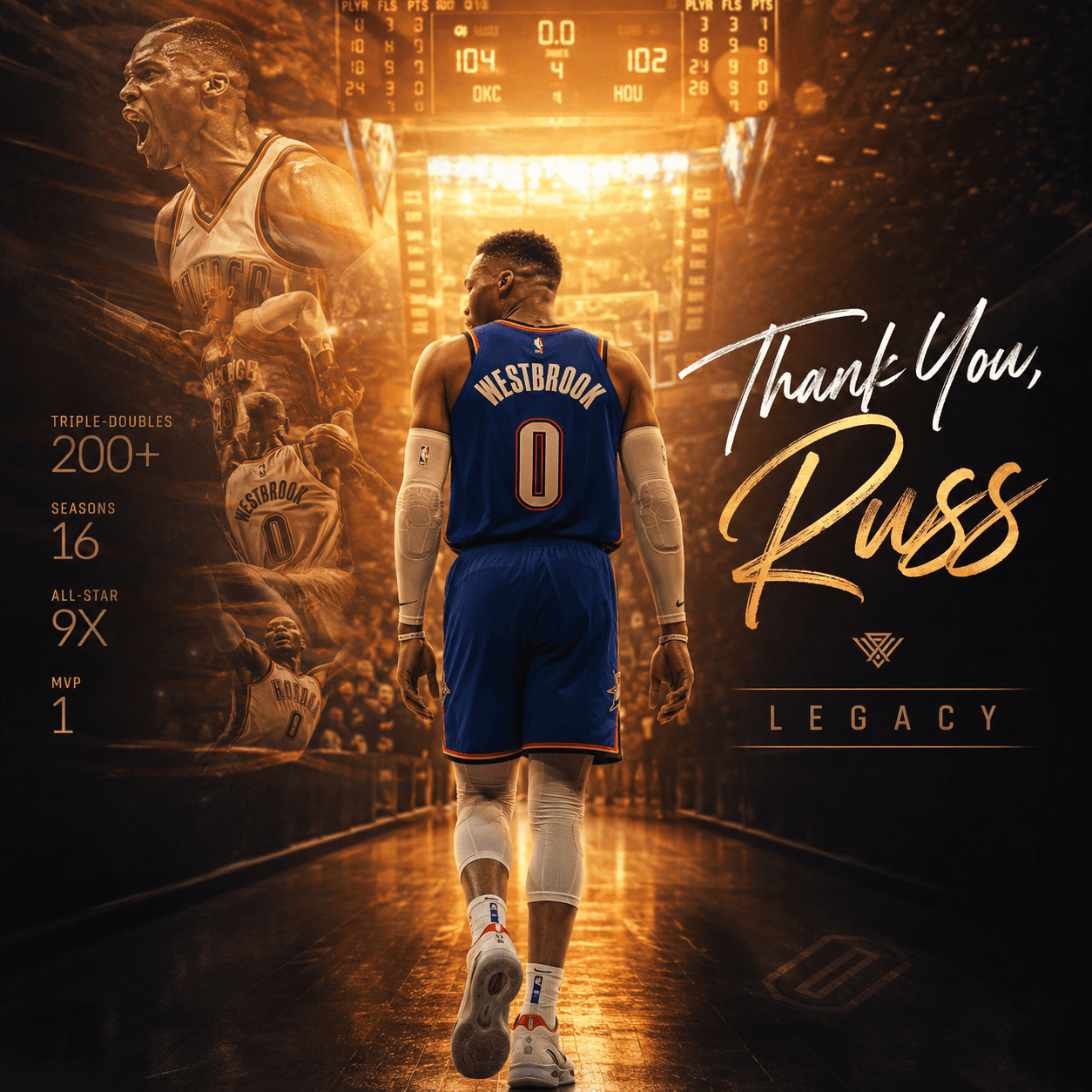
On August 12, 2026, Westbrook announced his retirement after 18 NBA seasons, closing a career that included an MVP award, nine All-Star selections, 27,176 points and an NBA-record 209 triple-doubles. The video was narrated by actor Michael B. Jordan and framed Westbrook’s career almost like an exhibit of memories, records and moments that could never fully explain what he meant to the game.
The Russell Westbrook retirement announcement immediately brought one question back to the center of NBA discussion: how should basketball remember a player who was simultaneously record-breaking, fiercely admired and constantly debated?
The answer starts with Oklahoma City, but it reaches far beyond one franchise.
According to the NBA’s official retirement coverage, Westbrook leaves the league as its career triple-double leader, fifth all-time in assists and 14th in scoring.
Russell Westbrook Retirement Ends One of the NBA’s Most Unique Careers
Westbrook retires at 37 after appearing in 1,301 regular-season games across seven franchises.
His career averages tell only part of the story:
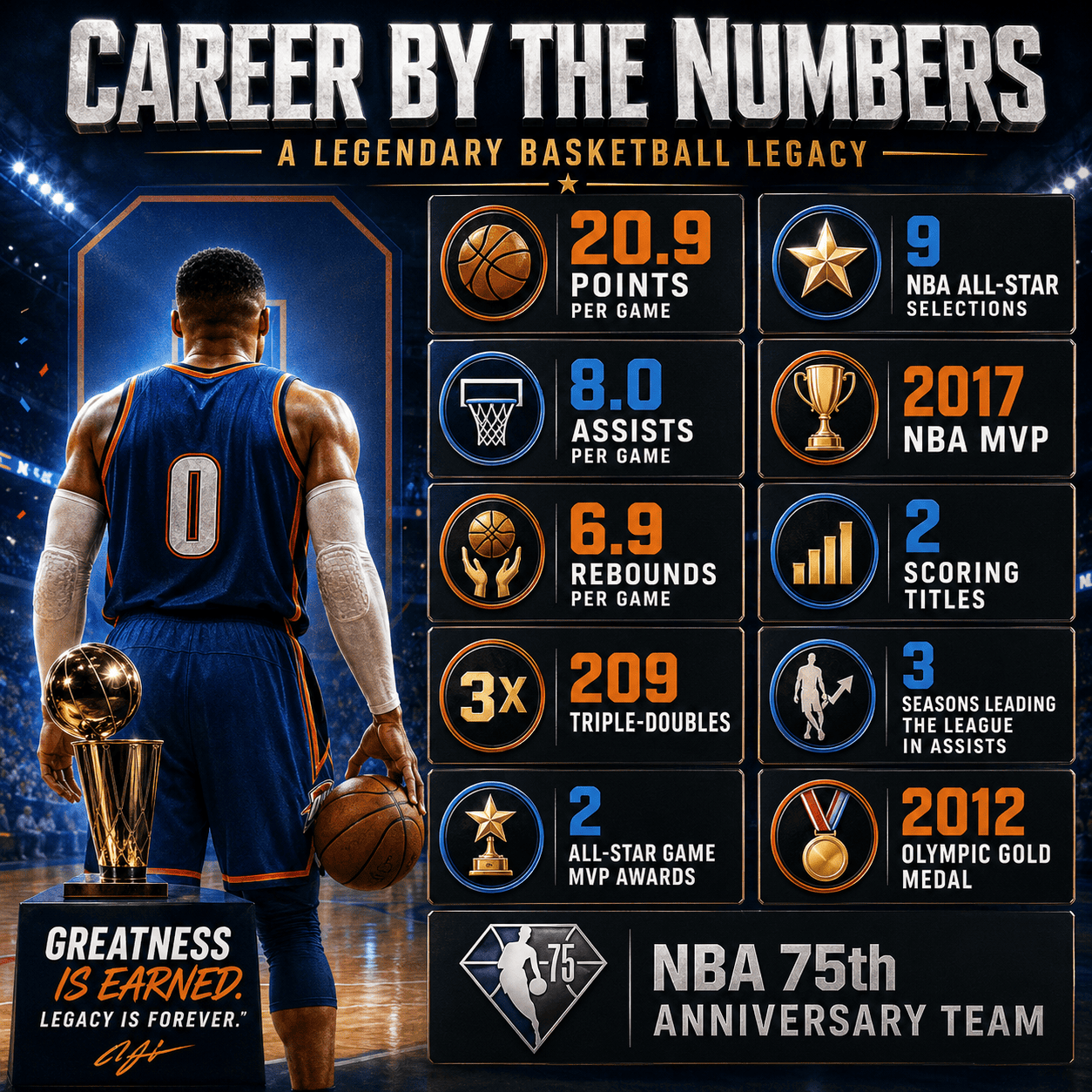
- 20.9 points per game
- 8.0 assists per game
- 6.9 rebounds per game
- 209 triple-doubles
- 9 NBA All-Star selections
- 2017 NBA MVP
- 2 scoring titles
- 3 seasons leading the league in assists
- 2 All-Star Game MVP awards
- 2012 Olympic gold medal
- NBA 75th Anniversary Team
He also finished with 10,351 career assists and 27,176 points, placing him among the most productive guards the league has ever seen.
Those numbers are remarkable on their own. What made Westbrook different was how he produced them.
Few guards in NBA history combined acceleration, strength, rebounding instinct and playmaking with the same level of constant aggression. He played as though every loose ball, fast break and transition possession mattered more than the previous one.
That style could be chaotic. It could also be overwhelming.
From the No. 4 Pick to the Face of Oklahoma City Basketball
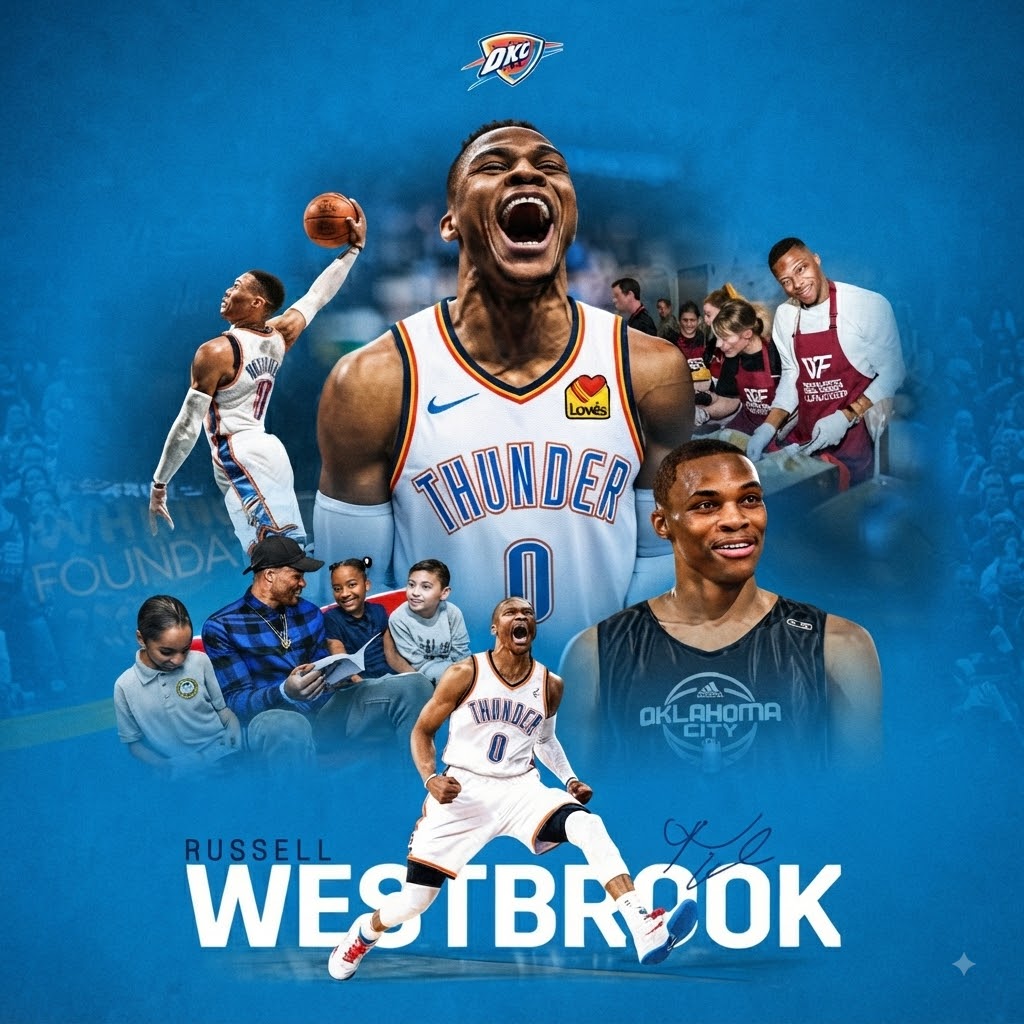
Westbrook entered the NBA as the fourth overall pick in the 2008 Draft, selected by the Seattle SuperSonics shortly before the franchise relocated to Oklahoma City. He would spend his first 11 seasons with the Thunder, becoming one of the central figures in the birth of professional basketball culture in Oklahoma City.
The young Thunder quickly grew into one of the league’s most exciting teams, with Kevin Durant providing elite scoring, James Harden developing into a future superstar and Westbrook bringing speed and physical force from the point guard position. Oklahoma City reached the Western Conference Finals in 2011 and advanced to the NBA Finals a year later, eventually falling to LeBron James, Dwyane Wade and the Miami Heat.
The core did not stay together forever, but Westbrook’s connection to Oklahoma City only became stronger. By the time Durant left for Golden State in 2016, the Thunder were no longer built around several young stars sharing the spotlight. Westbrook had become the unquestioned centerpiece, setting the stage for the season that would define his career.
The 2016-17 MVP Season Changed the Triple-Double Forever
Before the 2016-17 season, averaging a triple-double across an entire NBA campaign felt like a statistical relic. Oscar Robertson had done it in 1961-62. For more than five decades, no one repeated it. Then Westbrook averaged 31.6 points, 10.7 rebounds and 10.4 assists per game while carrying Oklahoma City back to the playoffs. He became the first player since Robertson to average a triple-double over a full season and won the 2017 NBA MVP award. He also recorded 42 triple-doubles, breaking Robertson’s previous single-season record of 41. The achievement was not merely a one-year statistical explosion.
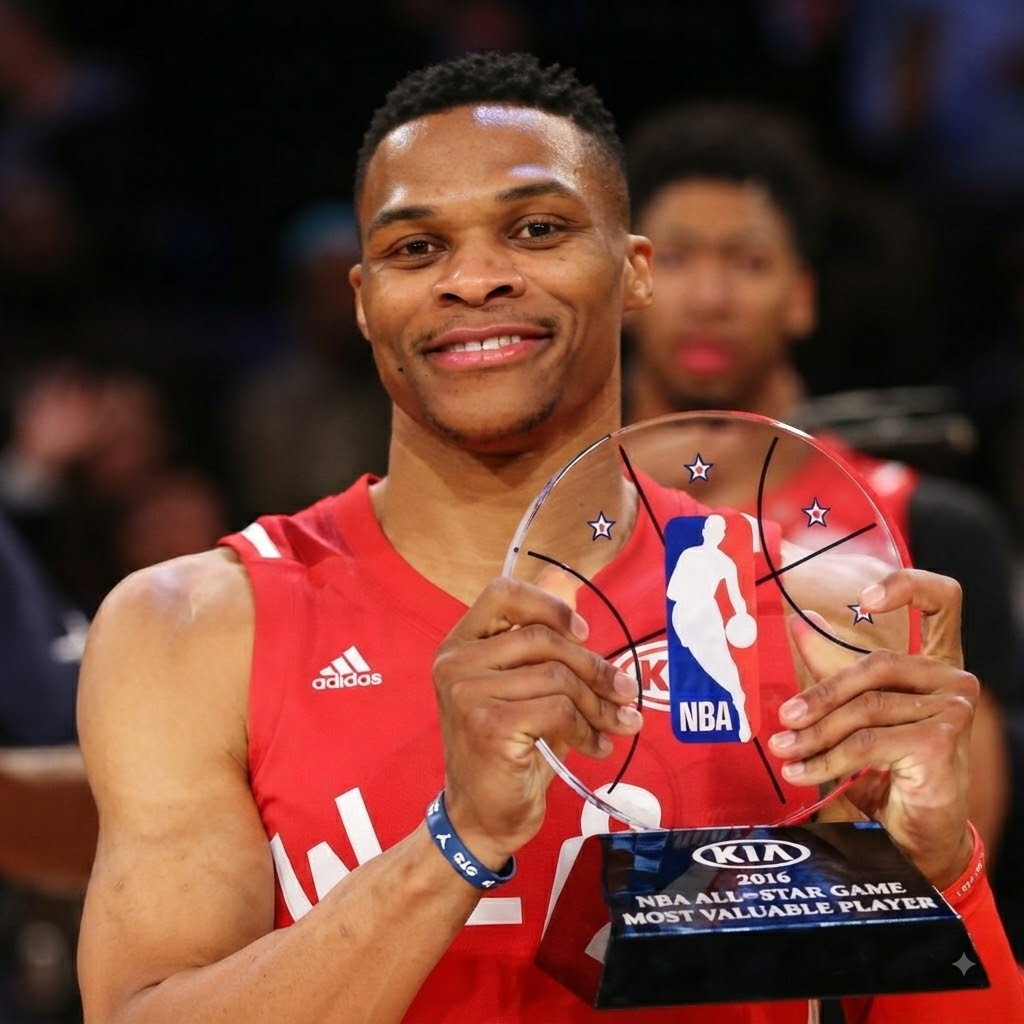
Westbrook eventually averaged a triple-double across four different seasons, something no other NBA player has accomplished. That changed how basketball audiences thought about the statistic. Before Westbrook, the triple-double often felt like a rare event worthy of its own headline. During his peak, it became almost an expectation.
209 Triple-Doubles Define a Record That May Last for Years
The number most closely associated with Russell Westbrook is now 209. That is how many regular-season triple-doubles he recorded before retiring, the most in NBA history. Critics occasionally questioned whether his pursuit of rebounds and assists placed too much emphasis on individual numbers. The debate will probably remain part of his legacy. But there is an important statistic that complicates the idea that Westbrook’s triple-doubles were merely empty production.
According to NBA.com, Westbrook’s teams went 153-56 in games in which he recorded a triple-double, a winning percentage of roughly .732. That does not settle every argument about efficiency or decision-making. It does show that his biggest statistical performances were very often connected with winning basketball. Westbrook did not invent the triple-double. He made it part of the vocabulary of an NBA generation.
Life After Oklahoma City Was Far More Complicated
Westbrook’s career changed dramatically after he left the Thunder in 2019.
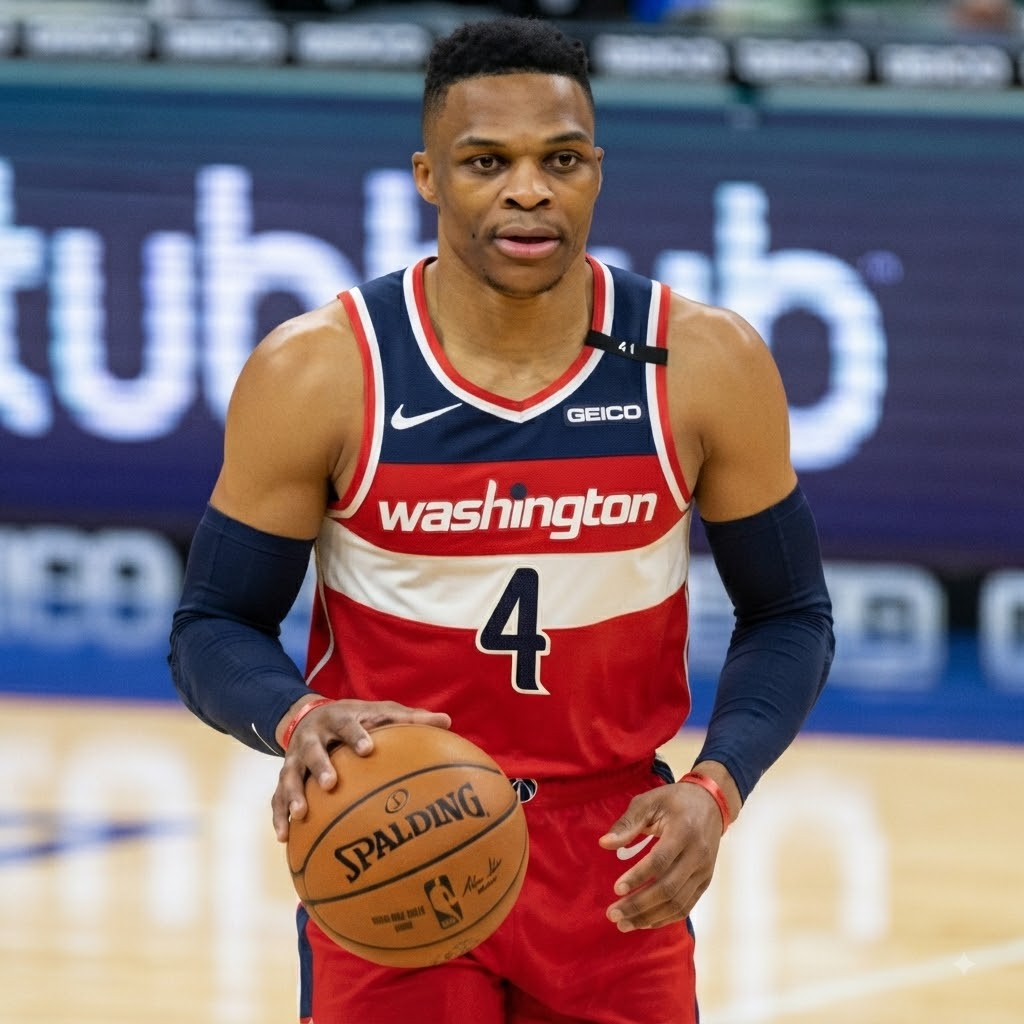
He played for the Houston Rockets, Washington Wizards, Los Angeles Lakers, LA Clippers, Denver Nuggets and Sacramento Kings after his Oklahoma City years.
What followed was a far less predictable chapter of his career. In Houston, Westbrook reunited with James Harden and averaged more than 27 points per game, while his lone season in Washington produced another triple-double average and a trip to the postseason. The move to the Lakers proved considerably more difficult, however, as a roster built around Westbrook, LeBron James and Anthony Davis never developed the chemistry expected from three high-profile stars. His shooting, ball dominance and overall fit became recurring subjects of criticism.
By the time he moved through the Clippers, Nuggets and eventually Kings, Westbrook was being asked to become a different kind of player—less of a franchise centerpiece and more of a secondary creator, bench contributor and veteran presence.
Sacramento Became the Final Stop
The final season of Westbrook’s career came with the Sacramento Kings in 2025-26.
He appeared in 64 games and started 58 of them, averaging 15.2 points and 6.7 assists per game.
That matters when considering the timing of the Russell Westbrook retirement.
He was not several years removed from meaningful NBA minutes. He was still starting regularly and still capable of producing triple-doubles late in his career.
His final one came in March 2026, extending his record to 209.
The retirement therefore feels less like a player disappearing quietly from the league and more like a deliberate ending.
Westbrook chose when his NBA story stopped.
Why Oklahoma City Will Always Be the Center of His Legacy
Westbrook wore seven NBA uniforms, but his basketball identity will always be tied most closely to Oklahoma City.
He arrived before the Thunder had established decades of local NBA history. Then he helped create it.
Sam Presti, Oklahoma City’s longtime general manager, emphasized Westbrook’s competitiveness, fearlessness and importance to the organization after the retirement announcement. Presti also pointed to Westbrook’s connection with the community as part of a legacy larger than statistics.
That connection explains why Westbrook remains so closely identified with Thunder basketball even after years spent elsewhere. For basketball fans who enjoy keeping team-inspired apparel, collectibles or everyday fan items around long after a particular era ends, the Dalas Market shop is one place to browse current sports and fan-oriented designs.
Westbrook’s retirement is the kind of moment that often sends longtime supporters back to memories of jerseys, playoff runs and players who defined a specific period in a franchise’s history.
The “Why Not?” Mindset Became Part of Westbrook’s Identity
Westbrook’s influence was never limited to box scores. His approach to basketball was built around confidence that sometimes appeared almost unreasonable.
That mentality became closely associated with the phrase “Why Not?”, and few slogans could have fit his career better. Westbrook played as if conventional limits were there to be challenged: why shouldn’t a 6-foot-3 guard dominate the glass, average a triple-double or repeatedly attack defenders much larger than himself?
The same approach also contributed to some of his flaws.
Westbrook rarely played cautiously. He attempted difficult passes, attacked crowded lanes and took shots that could frustrate coaches and fans. The things that made him extraordinary were often connected to the things that made him polarizing. Removing one side of that equation would make his career easier to summarize, but less truthful.
Where Does Westbrook Rank Among Modern Point Guards?
Ranking point guards across different NBA eras is always complicated. Magic Johnson, Stephen Curry, Oscar Robertson, Chris Paul, John Stockton, Steve Nash and others built greatness in very different ways.
Westbrook’s case is equally distinct. He does not have an NBA championship. His efficiency does not compare favorably with some of the most precise offensive guards in league history, and several postseason runs ended earlier than expected.
Even with those limitations, his résumé remains extraordinary: an MVP award, nine All-Star selections, more than 27,000 points, more than 10,000 assists, four seasons averaging a triple-double and an NBA-record 209 career triple-doubles.
None of that requires declaring Westbrook the greatest point guard ever. His place among Magic Johnson, Stephen Curry, Oscar Robertson, Chris Paul, John Stockton and Steve Nash will always depend on what a person values most when comparing eras. A more useful conclusion is that Westbrook created a category almost entirely his own—few point guards have ever influenced games through scoring, playmaking and rebounding in quite the same way.
Is Russell Westbrook a Future Hall of Famer?
Westbrook has not been inducted into the Naismith Memorial Basketball Hall of Fame, and the formal selection process still has to take place.
But his career résumé makes the expectation understandable.
NBA.com’s retirement analysis describes him among the great point guards of NBA history, while Oklahoma City’s leadership has already spoken about his career in Hall of Fame terms.
The records strengthen the case, but his influence may matter just as much.
Westbrook helped reshape expectations for what a point guard could contribute as a rebounder. He turned the triple-double from a historical curiosity into a realistic seasonal benchmark. And he played with a level of visible intensity that made neutral games feel personal.
That is a legacy difficult to reduce to one number.
Even if 209 is a very good place to start.
Russell Westbrook Retirement Marks the End of an NBA Era
The Russell Westbrook retirement announcement closes a career that was never quiet.
Westbrook played basketball at full volume, sprinting when others jogged, challenging bigger players for rebounds and attacking the rim with a level of urgency that rarely seemed to disappear. That approach produced spectacular moments, but it also came with missed shots, turnovers, difficult roster fits and postseason disappointments that will remain part of any balanced assessment of his career.
Yet those imperfections exist alongside an MVP season that changed NBA history, 209 triple-doubles, nine All-Star appearances and 18 years as one of basketball’s most recognizable competitors. The championship that eluded him will always be part of the discussion, but so will Oklahoma City, the triple-double revolution and the unmistakable intensity with which he approached the game.
The Russell Westbrook retirement does not close the book on every debate about his place in NBA history. It simply makes one conclusion easier to reach: Westbrook was never a perfect player, but there has rarely been a player quite like him—and that is why his era will be difficult to forget.
Frequently Asked Questions
When did Russell Westbrook retire?
Russell Westbrook announced his retirement on August 12, 2026, ending his NBA career after 18 seasons.
How many triple-doubles did Russell Westbrook have?
Westbrook finished with an NBA-record 209 regular-season triple-doubles. He also set the single-season record with 42 during his 2016-17 MVP campaign.
How many NBA teams did Russell Westbrook play for?
Westbrook played for seven franchises: Oklahoma City, Houston, Washington, the Los Angeles Lakers, LA Clippers, Denver Nuggets and Sacramento Kings.
Did Russell Westbrook win an NBA championship?
No. Westbrook reached the NBA Finals with Oklahoma City in 2012, but the Thunder lost the series to the Miami Heat.
What was Russell Westbrook’s best season?
His most celebrated season was 2016-17, when he averaged 31.6 points, 10.7 rebounds and 10.4 assists, recorded a then-record 42 triple-doubles and won the NBA MVP award.
Related post